
5 Questions Every Broker Should Ask After Open Enrollment

Open Enrollment is over, what are you doing next?
Booking a long weekend? Hitting the golf course? Going to Disneyland? The instinct to check out after OE can be real. Relief. Freedom. Gratitude for anything that isn’t another Open Enrollment conversation.
That makes sense. Open Enrollment is one of the most demanding moments in the benefits year, and once it’s behind you, the instinct is to move on fast. But that instinct — to rush straight past reflection — is also one of the biggest missed opportunities for many brokers.
The weeks immediately after Open Enrollment are when the clearest signals finally surface. It’s when HR leaders are most honest about where things were bumpy. It’s also when broker teams are clearest on exactly where they had to step in manually or where things felt fragile — even if everything technically finished on time.
Open Enrollment leaves behind a lot of clues: about confidence, effort, communication, and sustainability. Ignoring those clues doesn’t make them disappear. They tend to show up later as more avoidable work next year.
So before you pack up those clubs or catch a plane to the beach, it’s worth investing in a few focused conversations that can pay off well beyond this enrollment cycle — in stronger client relationships, higher satisfaction, and a book of business that gets easier to manage over time.
That’s exactly why we built The Broker’s OE Post-Mortem Guide, a practical framework that pairs a quick client Pulse Check with a Broker Worksheet and a full set of questions designed to surface what actually happened during Open Enrollment. It helps brokers capture insight while it’s fresh, translate it into clear patterns, and decide where effort will matter most next year.
The guide includes a broad range of questions worth asking. But if you had to focus on just a few — the ones that consistently separate healthy enrollments from fragile ones — what would they be?
Here are the five that matter most.
The 5 Questions Every Broker Should Ask After Open Enrollment
If you had to focus on just a handful of questions after Open Enrollment — the ones that consistently reveal whether an enrollment was truly healthy or quietly fragile — these are the five that matter most.
They’re designed to be asked in sequence, but they work just as well on their own. And while they’re part of a broader post-OE framework, these questions do the heavy lifting when time and attention are limited.
1. Did this Open Enrollment feel more controlled than last year — or just more familiar?
This question sets the tone.
Many OEs feel “better” simply because everyone knows what to expect. That’s not the same thing as being easier, calmer, or more sustainable. An enrollment can feel smoother while still relying on the same late fixes, manual follow-ups, and behind-the-scenes effort.
If things felt more controlled and required less effort, that’s a strong signal of real improvement. If they felt familiar but still exhausting, that’s usually a sign that structure hasn’t changed — people just powered through again.
This question helps you separate progress from repetition.
2. How confident were employees when making their decisions?
HR leaders see confidence (or lack of it) through behavior:
repeated questions, second-guessing, delayed decisions, or regret after OE closes.
This matters because our research shows that more than 1 in 3 employees regret a benefits decision, and nearly 7 in 10 spend an hour or less choosing benefits for the entire year . That combination makes confidence fragile — even when enrollment technically goes “fine.”
Frequent confusion usually points to gaps in timing, decision support, or clarity. But low confusion doesn’t always mean high confidence either. Sometimes it signals rushed decisions or disengagement.
This question helps you understand whether silence reflects confidence — or avoidance.
3. Where did communication work — and where did it create more work?
Most clients send plenty of OE communications. The real question is whether those messages reduced effort or shifted it.
Look for patterns like:
- Strong engagement paired with high HR effort
- Messages that landed only after manual reinforcement
- Channels that drove action versus channels that drove questions
This isn’t about sending more communication. It’s about understanding where communication actually carried the load — and where people stepped in to compensate.
That distinction is critical for reducing noise next year.
4. How much pressure did Open Enrollment put on HR?
HR workload is one of the clearest indicators of OE health.
When OE works well, effort feels manageable and predictable. When it doesn’t, pressure escalates quickly — sometimes quietly, sometimes visibly.
If HR workload felt manageable but question volume was still high, strain may have been absorbed by a few people. If both workload and questions were high, that usually points to structural issues that won’t scale.
This question helps you pinpoint where automation, pacing, or clearer ownership could materially reduce pressure — not just during OE, but throughout the year.
5. If nothing changes, what’s most likely to break next year?
This is the most important question — and the most forward-looking.
Rather than asking clients to fix everything, ask them to predict the single most likely failure point if nothing changes:
- Communication gaps?
- Eligibility confusion?
- Manual processes that won’t scale?
- Compliance confidence?
This reframes improvement as prevention, not criticism. It creates urgency without alarmism and keeps the conversation focused on what actually matters.
Most of the time, a small number of changes address the majority of risk.
Turning Insight into Better Broker Outcomes
These five questions aren’t meant to replace a full post-OE review. They’re meant to focus it.
When brokers use them consistently — often alongside a short Pulse Check and a structured internal worksheet — they gain a clearer view of which clients need intervention, which are stable, and where effort will deliver the biggest return.
That clarity leads to:
- More productive renewal conversations
- Stronger client trust
- Less OE-related noise (and work) year over year
- A book of business that scales without constant triage
This is where many brokers partner with their team at Selerix to review findings, pressure-test assumptions, and identify practical ways to reduce manual work or improve employee decision support — without overengineering the solution.
Want to learn more and download our sample Client Survey and Broker Worksheets?
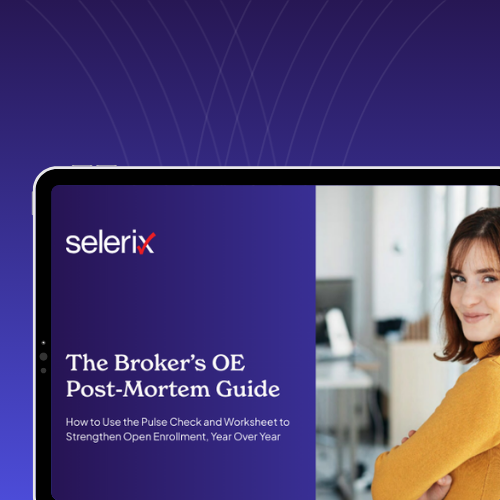
Download the full Post-OE Post-Mortem Guide— and start transforming Open Enrollment from a once-a-year sprint into a smarter, more predictable cycle.
Open Enrollment doesn’t have to be something you simply get through each year. With the right questions — and the right structure behind them — it becomes one of the most reliable ways to reduce future effort, strengthen client trust, and set the next OE up for success.
And when you do finally head to Disneyland, the beach, or the golf course, it’s a lot easier to relax knowing next year’s enrollment will be all the better for it.


