
Reflections from 2025 Open Enrollment: What We Learned and How to Prepare for 2026

Open Enrollment 2025 may be behind us, but for many organizations, the impact is still being felt.
In our recent webinar, Reflections from 2025 OE — A Practical Roadmap for 2026, we asked a simple but revealing question:
Where does your organization feel the most risk or frustration today?
The results told a powerful story:
- 50% said employee communication and engagement
- 31% said post–Open Enrollment data cleanup and corrections
- 13% said vendor or carrier coordination
- 6% said compliance tracking and reporting
These results reinforce what we continue to see across brokers, HR teams, and benefits administrators: Open Enrollment challenges don’t end when enrollment closes.
Let’s break down what we learned—and how to move forward.
The Lingering Impact of Post-OE Data Cleanup
Data accuracy remains one of the biggest drivers of post-OE stress.
Organizations reported challenges with:
- Inconsistent employee or dependent data across systems
- Payroll deduction discrepancies
- Carrier file mismatches
- Manual corrections under compressed timelines
Even something as small as a dependent date of birth being off by one day in two systems can create significant downstream issues. When timelines are tight—especially during the holidays—manual processes increase the risk of error.
The takeaway: Data validation shouldn’t wait. Q1 and Q2 are the most impactful times to audit eligibility, confirm payroll deductions, and ensure carrier feeds are running correctly. Early detection prevents costly retroactive fixes later in the year.
Communication Is Still the Biggest Differentiator
The strongest signal from our poll? Communication.
Only about one in four employees say they fully understand their benefits. That means the majority are making important financial decisions with limited clarity.
We heard recurring themes:
- Employees overwhelmed by too many decisions in a short window
- Confusion when transitioning from passive to active enrollment
- Uncertainty about where to go for help
- Increased post-enrollment corrections due to rushed decisions
Interestingly, employees consistently expressed appreciation for simple, clear communication when it was available.
More information isn’t always better. Clear, targeted, and well-timed communication wins every time.
Brokers as Communication Leaders
One of the biggest opportunities we discussed is the evolving role of brokers.
Brokers are no longer just renewal partners—they are communication leaders and strategic advisors. That means helping clients:
- Set realistic timelines
- Align messaging across vendors and carriers
- Simplify complex benefit changes
- Introduce decision support tools
- Treat Open Enrollment as a year-round process
The fastest path to improving 2026 Open Enrollment isn’t waiting until Q4—it’s fixing communication and process gaps now.
Open Enrollment Is a Year-Round Strategy
A major shift we’re seeing: organizations that treat Open Enrollment as a continuous process see better outcomes.
Instead of a two-week event, successful teams:
- Send monthly wellness or benefit reminders
- Align communication with health awareness campaigns
- Educate employees on plan utilization throughout the year
- Encourage review of first pay stubs to catch deduction issues early
When benefits education happens consistently, employees feel more confident—and Open Enrollment becomes less overwhelming.
The 2026 Roadmap: What to Focus on Now
We also shared a full-year roadmap to reduce stress and spread work evenly:
Q1: Reflect & Assess
- Conduct post-OE debriefs
- Send employee surveys (get a template here!)
- Identify communication and process gaps
- Set measurable goals for 2026 (here’s a quick guide)
Q2: Fix & Align
- Audit data accuracy
- Confirm vendor and carrier alignment
- Refine communication strategy
Q3: Prepare
- Finalize plan changes
- Simplify messaging
- Coordinate with carriers
Q4: Execute
- Reinforce guidance
- Monitor enrollment progress
- Support employee decision-making
Following this structure dramatically reduces year-end pressure.
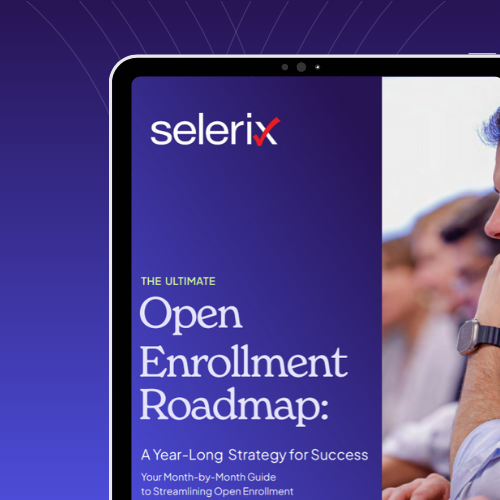
Grab our Open Enrollment Roadmap for a full break down of monthly tasks, for the entire year.
Compliance: Don’t Overlook March Milestones
Healthcare compliance remains a vulnerable area, particularly around ACA and COBRA.
Key priorities include:
- Verifying eligibility tracking and measurement methods
- Ensuring ACA reporting accuracy
- Reviewing COBRA workflows and documentation
- Identifying data risks before year-end
Addressing these items early builds confidence and prevents compliance fire drills later.
Listening Is a Competitive Advantage
One of the most important themes from the webinar: Act on feedback.
More than one-third of employees report regretting a benefit decision at some point. That’s not just a communication issue—it’s a trust issue.
Post-OE surveys help uncover:
- Where communication fell short
- Which plans caused hesitation
- What tools employees found confusing
When employees share feedback, treat it as insight—not criticism. Use it to refine your approach for 2026.

Final Takeaways
Open Enrollment 2025 reinforced three truths:
- Clean data prevents downstream chaos.
- Communication is the single biggest differentiator between smooth and stressful OE cycles.
- The best time to fix Open Enrollment is now—not in the fall.
If there’s one shift to make heading into 2026, it’s this:
Treat Open Enrollment as a year-round strategy, not a seasonal event.
The organizations that reflect early, align data and vendors, and commit to clear communication will enter the next Open Enrollment cycle with confidence.


