
What Open Enrollment Feedback Really Tells You (And What to Do With It)

Open Enrollment is officially over. Employees made their selections, deadlines were met, and HR teams can finally come up for air.
But while enrollment may be complete, the story of this year’s Open Enrollment experience isn’t finished yet. In fact, the most valuable insights often come after the last enrollment confirmation is submitted.
Post–Open Enrollment feedback isn’t just a box to check or a satisfaction score to record. When used correctly, it’s a diagnostic tool — one that shows exactly where employees felt confident, where they felt confused, and where friction got in the way of good decisions.
Think of it less like a report card… and more like reviewing game film after the season ends.
Post-OE Feedback Is More Than a Satisfaction Score
It’s easy to look at survey results and feel relieved when the numbers look “good enough.” Participation was high. Complaints were minimal. The average rating landed somewhere between “fine” and “pretty good.”
But surface-level scores rarely tell the full story.
Post-OE feedback is valuable because it captures how employees experienced enrollment, not just whether they completed it. Patterns in responses — neutral ratings, vague comments, repeated questions — often point to underlying issues that don’t show up in completion metrics alone.
That’s why timing matters. Feedback collected shortly after Open Enrollment closes is more honest, more detailed, and far more actionable than surveys sent months later, when memories have faded and frustration has turned into resignation.
What Employees Are Really Saying (Even When They Don’t Say It Directly)
Employees don’t always spell out problems clearly in surveys. But when you know what to look for, their feedback speaks volumes.
“It Was Fine” Often Means “I Just Got Through It”
Neutral or non-descriptive responses are common after OE — and they’re rarely a sign of success. More often, they signal cognitive overload.
Employees may have felt rushed, overwhelmed, or unsure, but pushed through simply to meet the deadline. These are the same employees who are most likely to regret their benefits choices later, once they actually start using them.
Confusion Is Usually a Communication Issue
When employees mention unclear options, too much information, or last-minute questions, the issue isn’t employee capability — it’s communication design.
Feedback often reveals:
- Messages sent too late or all at once
- Important details buried in long emails
- Inconsistent messaging across channels
This is where year-round benefits communication tools like Selerix Engage can make a meaningful difference — delivering clear, timely, and targeted messages instead of a single OE information dump.
Friction Points Signal Process or Platform Gaps
Comments about navigation issues, difficulty comparing plans, or uncertainty during enrollment typically point to process friction — not “user error.”
A streamlined enrollment platform like BenSelect helps reduce this friction by guiding employees through decisions with intuitive workflows, clear plan comparisons, and built-in support — making it easier for employees to feel confident rather than rushed.
The Most Common OE Experience Gaps Feedback Uncovers
Across organizations, post-OE feedback tends to surface the same challenges year after year:
- Employees didn’t fully understand plan differences
- Communications felt overwhelming or poorly timed
- Tools weren’t intuitive or mobile-friendly
- Support wasn’t easy to find when questions arose
- Employees weren’t confident they made the right choice
In other words, many employees crossed the finish line — but not without tripping along the way.
What Happens When Feedback Is Ignored
Collecting feedback without acting on it can quietly undermine trust.
Employees notice when surveys disappear into a black hole. Over time, that leads to lower participation, less honest responses, and growing disengagement — not just with Open Enrollment, but with benefits overall.
Ignoring feedback also creates a cycle where the same issues repeat year after year, increasing stress for HR teams and eroding confidence among employees.
As we’ve discussed before, benefits experiences directly influence how employees feel about their employer. Nearly two-thirds of employees report that a poor enrollment experience could push them to look elsewhere, making Open Enrollment not just an administrative task — but a retention moment. (Source: 2025 Selerix Human Economics of Employee Benefits)
Related read: Why Employees Regret Their Benefits Choices — And How HR Can Help
Turning OE Feedback Into Real Improvements
The goal of post-OE feedback isn’t perfection — it’s progress.
A practical approach looks like this:
- Collect feedback quickly, while experiences are fresh
- Look for trends, not one-off complaints
- Prioritize a few high-impact improvements
- Communicate what you learned and what’s changing
- Use insights to shape year-round benefits communication
Even small adjustments — clearer messaging, better timing, simpler enrollment steps — can dramatically improve the next Open Enrollment experience.
This is where combining Engage for ongoing communication and BenSelect for enrollment execution helps turn feedback into action, not just insight.
Feedback Is the First Step in a Better Open Enrollment Experience
Great Open Enrollment experiences don’t start at launch day. They start months earlier — with listening.
Post-OE feedback sets the foundation for:
- Smarter planning
- Clearer communication
- Better employee confidence
- Less stress for HR
It’s the first step in building a year-round benefits experience that feels intentional instead of reactive.
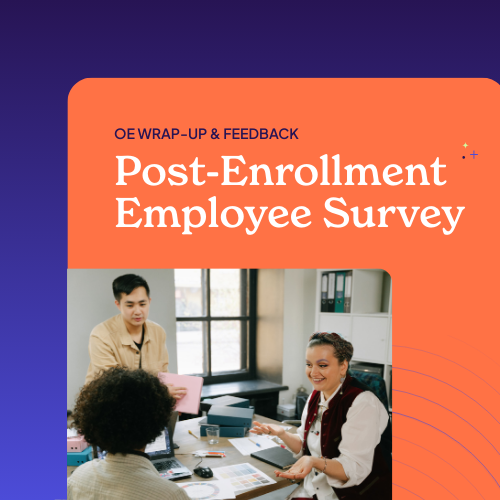
Download the Post–Open Enrollment Feedback Toolkit
To help you turn employee insight into action, we’ve created a Post–Open Enrollment Feedback Toolkit designed to make feedback collection simple, timely, and effective.
Inside, you’ll find:
- A ready-to-use employee feedback survey template
- Best practices for distribution and anonymity
- Guidance on analyzing results and sharing outcomes
- A structured way to turn feedback into improvement
Because the best Open Enrollment improvements don’t happen during enrollment —
they start by listening after it ends.


