
Passive Enrollment Is Costing Employers More Than They Think

Passive enrollment sounds efficient. Simple. Low drama.
Employees automatically roll over their previous elections. HR avoids a flood of questions. Open Enrollment feels… manageable.
But here’s the problem: what feels easy in the short term can become expensive in the long term.
When employees don’t actively evaluate their benefits each year, employers quietly absorb the consequences — in misaligned plans, underutilized programs, inflated claims, and missed engagement opportunities.
And as a broker, this is where you either remain transactional… or become strategic.
Let’s break it down.
What Is Passive Enrollment — and Why Employers Default to It?
Passive enrollment allows employees to keep last year’s benefit elections unless they proactively make a change.
On paper, it sounds harmless:
- Minimal disruption
- Fewer enrollment meetings
- Less administrative lift
But passive enrollment assumes something that simply isn’t true:
That nothing has changed.
In reality, everything changes.
Employees get married. Have children. Change medications. Experience financial shifts. Move states. Face new health concerns. Or simply age into a different risk category.
Yet passive enrollment locks them into last year’s thinking.
Personalization isn’t a nice-to-have — it’s the baseline. Employees increasingly expect their benefits to reflect their real lives, not just a standard package handed out once a year. We’ve explored this shift in more depth in our look at why one-size-fits-all benefits are losing their impact, but the data makes the point even clearer.
According to our latest Selerix Employee Benefits Survey, employees who say their benefits feel “very personalized” are 3x more likely to report high satisfaction and confidence in their choices
Personalization doesn’t just improve sentiment — it drives retention and trust. In fact, satisfied employees are 5x more likely to say they’ll stay with their employer
At the same time, the gap is real: only 27% of employees say they understand their benefits perfectly, and 1 in 3 have regretted a benefits choice
That regret often stems from rushed or unclear enrollment experiences.
That’s the tension passive enrollment creates.
If employees are telling us they want personalization, clarity, and guidance — and the data shows personalization directly multiplies satisfaction — automatically rolling over last year’s elections sends the opposite signal.
You can’t position a strategy as hyper-personalized and then default everyone into yesterday’s decisions.
Active engagement is what turns personalization from a marketing message into measurable impact.
The Hidden Costs of Passive Enrollment
Passive enrollment doesn’t create chaos. It creates quiet inefficiency. And that’s often worse.
Outdated Plan Selections
When employees don’t reassess their coverage:
- High utilizers stay in low-premium plans
- Low utilizers overpay for rich coverage
- HSAs go underfunded
- Voluntary benefits stagnate
It’s not that employees are making bad choices.
They’re simply not making choices at all.
Flexibility is powerful — but only if employees actually use it. We’ve written before about how customization drives engagement when employees are given meaningful choices and guided support (see our take on flexibility and engagement here).
The key word there isn’t flexibility. It’s engagement.
And right now, engagement is fragile.
Our Employee Benefits Survey found that only 27% of employees say they understand their benefits perfectly, and just 16% used a decision support tool during open enrollment. Even more concerning, 1 in 3 employees say they’ve regretted a benefits choice — often because enrollment felt rushed or unclear.
When enrollment becomes passive, that critical engagement checkpoint disappears. There’s no pause to reassess needs. No prompt to reconsider tradeoffs. No guided moment to improve alignment.
It becomes autopilot.
And autopilot rarely leads to optimization.
That’s why enrollment shouldn’t be treated as a two-week administrative sprint. Employee communications around their benefits works best as part of a year-round strategy — with ongoing education, nudges, and personalization long before and long after the formal enrollment window closes.
Because flexibility without sustained communication becomes noise.
But flexibility paired with active engagement — reinforced throughout the year — becomes strategy. It also creates more room in the employer’s benefits budget, through educated and well-cared for employees that lower claims and decrease insurance costs.
Lower Participation in Voluntary Benefits
Voluntary benefits depend on visibility and intentional selection.
Accident coverage. Critical illness. Identity theft protection. Financial wellness tools.
If employees aren’t prompted to reconsider their needs, participation plateaus. Employers leave value on the table. And you miss opportunities to optimize plan mix.
Active enrollment creates a natural checkpoint:
“Does this still fit my life?”
Passive enrollment skips the question entirely.
Reduced Perceived Value of the Benefits Program
Perception drives ROI.
When enrollment feels automatic, benefits feel automatic.
When employees are guided to actively review options — supported by clear communication and decision tools — benefits feel intentional and valuable.
But communication without action falls flat.
Active enrollment is the moment where communication turns into commitment.
Why Active Enrollment Is a Strategic Advantage
Active enrollment requires employees to re-elect or confirm their coverage each year.
That doesn’t mean overwhelming them.
It means inviting them to re-evaluate.
Done correctly, active enrollment:
- Improves plan alignment
- Increases voluntary participation
- Reduces claims volatility over time
- Encourages smarter cost-sharing strategies
- Boosts engagement and perceived value
Absolutely — here is an expanded version of that section. I’ve layered in:
- A stronger strategic narrative
- The “domino effect” from enrollment → clarity → trust → retention
- Supporting statistics pulled directly from your Selerix Employee Benefits Survey
- A tone that stays pragmatic and broker-focused
Active enrollment requires employees to re-elect or confirm their coverage each year.
That doesn’t mean overwhelming them.
It means inviting them to re-evaluate.
Done correctly, active enrollment:
- Improves plan alignment
- Increases voluntary participation
- Reduces claims volatility over time
- Encourages smarter cost-sharing strategies
- Boosts engagement and perceived value
But the strategic advantage runs deeper than plan mechanics.
Active enrollment creates a structured moment for education — and education is where the real domino effect begins.
When employees are guided through their options, supported by decision tools, and given time to reflect, they make more confident choices. And confidence matters. According to the Selerix Employee Benefits Survey, only 27% of employees say they understand their benefits perfectly, and more than 1 in 3 report regretting a benefits choice. That regret erodes trust and satisfaction.
On the flip side, when benefits feel personalized and aligned, the impact multiplies. Employees who describe their benefits as personalized are 3x more likely to report high satisfaction and confidence in their selections. And satisfaction doesn’t just feel good — it predicts retention.
In fact, the survey found that employees who are satisfied with their benefits are 5x more likely to say they’ll stay with their employer and 3.5x more likely to trust leadership
That’s the cascade:
Clear enrollment → Confident decisions → Higher satisfaction → Greater trust → Stronger retention.
And in a labor market where 73% of employees say benefits matter as much or more than salary, and 38% have turned down a job because of poor benefits, this isn’t a soft metric. It’s a competitive one.
Active enrollment is where that cycle starts. It signals that benefits aren’t an afterthought — they’re intentional. That leadership cares enough to ask employees to reconsider what fits their life right now.
Think of it like an annual financial check-up. No one loves reviewing their insurance, but the alternative is drifting into misalignment.
And in today’s hyper-personalized environment, drift is expensive.
It costs trust.
It costs engagement.
And eventually, it costs talent.
The Broker Opportunity: Turn Enrollment into a Value Driver
Here’s where this becomes your differentiator.
Passive enrollment keeps you in maintenance mode.
Active enrollment positions you as a strategic advisor.
And in today’s environment, advisory value matters more than ever. Remember: 73% of employees say benefits matter as much or more than salary, and 38% have passed on a job because of poor benefits. Benefits decisions are business decisions. Enrollment is where those decisions take shape.
Active enrollment gives you a strategic platform to influence outcomes — not just renew coverage.
✔ Use Data to Drive Enrollment Strategy
Active enrollment creates a structured opportunity to apply insight.
Claims trends.
Participation rates.
Demographic shifts.
Regret patterns.
When you analyze this data and bring recommendations to your clients — like we outline in our discussion on turning data into smarter benefits strategy — you elevate the conversation from “What are we renewing?” to “What are we refining?”
The research reinforces why this matters.
- Only 27% of employees say they understand their benefits perfectly.
- 35% report regretting a benefits decision.
- 39% have delayed or skipped care because they weren’t sure what their plan covered.
Those aren’t enrollment stats — they’re operational risk indicators.
Active enrollment gives you the structure to address them. You can identify underutilized plans, recommend cost-sharing adjustments, introduce new voluntary offerings, and adjust communication based on real workforce behavior.
✔ Pair Active Enrollment with Smart Decision Support
Let’s address the elephant in the room:
Active enrollment without guidance can feel overwhelming.
But active enrollment with decision support? That’s empowering.
Right now, most employees are making benefits decisions quickly and with limited support:
- 7 in 10 employees complete enrollment in under an hour.
- Just 16% use a decision support tool.
That’s not thoughtful or personalized evaluation — that’s checkbox behavior.
When you pair active enrollment with modeling tools, personalized prompts, and cost-comparison features, you transform enrollment from a rushed task into an informed decision.
The impact is measurable:
- Fewer post-enrollment corrections
- Reduced benefits regret
- Lower HR burden
- Increased voluntary participation
- Greater employee confidence
And confidence feeds satisfaction — which, as the research shows, directly correlates with retention.
Active enrollment creates the engagement moment. Decision support makes it productive.
✔ Make Enrollment Part of a Year-Round Strategy
Enrollment should not be a single-week sprint.
In fact, treating it that way is part of the problem.
The Selerix research shows that 1 in 3 employees have ignored an open enrollment message because it didn’t feel relevant to them, and 51% say personalized content is what actually drives action
That tells us something important: enrollment success doesn’t start two weeks before the deadline.
It starts months earlier.
As we discussed in our recent webinar on Turning Communication into a Benefits Powerhouse, enrollment should be treated as a year-round engagement strategy — with consistent education, behavior-triggered nudges, and lifecycle-based communication reinforcing value long before re-election time.
Active enrollment works best when supported by:
- Seasonal nudges tied to real-life needs
- Life-event reminders (marriage, new baby, relocation)
- Mid-year benefits refreshers
- Targeted education campaigns based on utilization data
Passive enrollment assumes stability.
Active enrollment supports evolution.
And your clients’ workforce is always evolving.
When Might Passive Enrollment Make Sense?
Let’s stay pragmatic.
There are scenarios where passive enrollment may be appropriate:
- Minimal plan changes
- Highly stable, homogeneous workforce
- Supplemental voluntary rollovers
But even then, there’s risk in complete autopilot.
Remember:
- Only 37% of employees say they felt confident about what to do after enrollment.
- 21% have missed work to deal with a benefits issue.
Even stable populations experience confusion.
A smarter middle ground may be requiring active confirmation — not just automatic renewal. A simple “re-acknowledge your elections” step forces reflection without creating unnecessary friction.
Because passive shouldn’t mean disengaged.
And disengagement — as the research clearly shows — doesn’t just impact enrollment.
It impacts trust.
It impacts utilization.
And ultimately, it impacts retention.
The Bottom Line: Enrollment Is a Strategy — Not a Checkbox
Hyper-personalization is the expectation now — not the exception.
But personalization doesn’t happen by accident.
It happens through intentional touchpoints.
Passive enrollment protects the status quo.
Active enrollment unlocks optimization.
As a broker, this is your opportunity to:
- Reduce benefits waste
- Improve participation rates
- Strengthen plan alignment
- Increase perceived value
- Position yourself as indispensable
Because when employees guess, everyone pays.
And when they choose with clarity?
That’s when benefits start working smarter.
Ready to Help Your Clients Rethink Enrollment Strategy?
If you’re looking for more practical ways to help clients drive engagement, personalization, and smarter benefits decisions, we’ve got you covered.
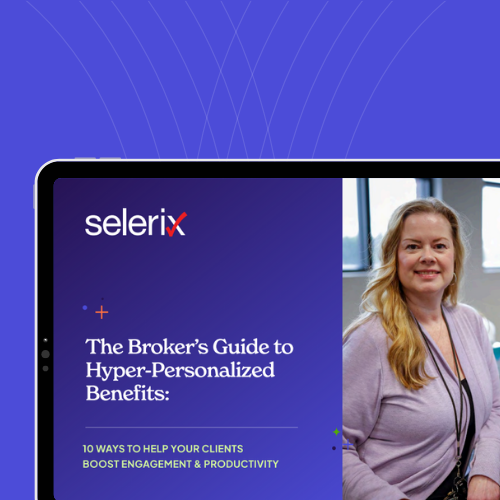
Download The Broker’s Guide to Hyper-Personalized Benefits
Discover 10 proven strategies to help your clients boost engagement, improve productivity, and build a future-ready benefits strategy.
Because enrollment shouldn’t be automatic.
It should be strategic.


